
- Buy Crypto
- Markets
- Futures
- Spot
- Copy Trade
 Earn
Earn- More
Tether, which has "enriched" itself through stablecoins, is now heavily investing in AI

Original Title: "AI Industry, Here Comes Cash-Rich Tether"
Original Author: Kuri, Deep Tide TechFlow
Tether earned $13 billion in 2024.
This number may not mean much to you. Let's put it another way: OpenAI had $3.7 billion in revenue in 2024 but lost $5 billion. Anthropic had $1 billion in revenue but also lost $5 billion.
The combined losses of these two reputable AI companies are still less than what Tether earned in a year.
Tether has 150 employees, while OpenAI has over 3000 employees. The difference in per capita output is approximately:
60 times.
How does Tether make money? You buy 1 USDT for $1, they take that $1 and buy US Treasury bonds. The bond interest goes to them, not you.
The essence of this is that Tether does not pay interest. Banks have to pay interest on deposits, but Tether doesn't. When you exchange your money for USDT, holding it, you earn zero interest. They take your money to buy US Treasury bonds, and in 2024 alone, they earned $7 billion in interest.
With 150 people overseeing over $130 billion in Treasury bonds, they don't have to do anything, as the interest comes in by itself.
Anybody would want to take it easy with such a business.
But when you have a lot of money, you have to spend it somehow. Tether chose a direction:
AI.
And it's not just about randomly investing in a couple of projects.
Let's talk about computational power first.
AI computation requires GPUs, the more, the better, and the more expensive, the better. Tether provided a loan of over $600 million to a German company, Northern Data.
What does this company do?
It's Europe's largest GPU cloud service provider. With over ten thousand Nvidia H100 GPUs, the same type used by OpenAI to train GPT, each costing two to three thousand dollars.
This cluster of GPUs ranks 26th in the world's TOP500 supercomputers. The $600 million that Tether poured in is essentially buying an AI training base in Europe.
Talking Data.
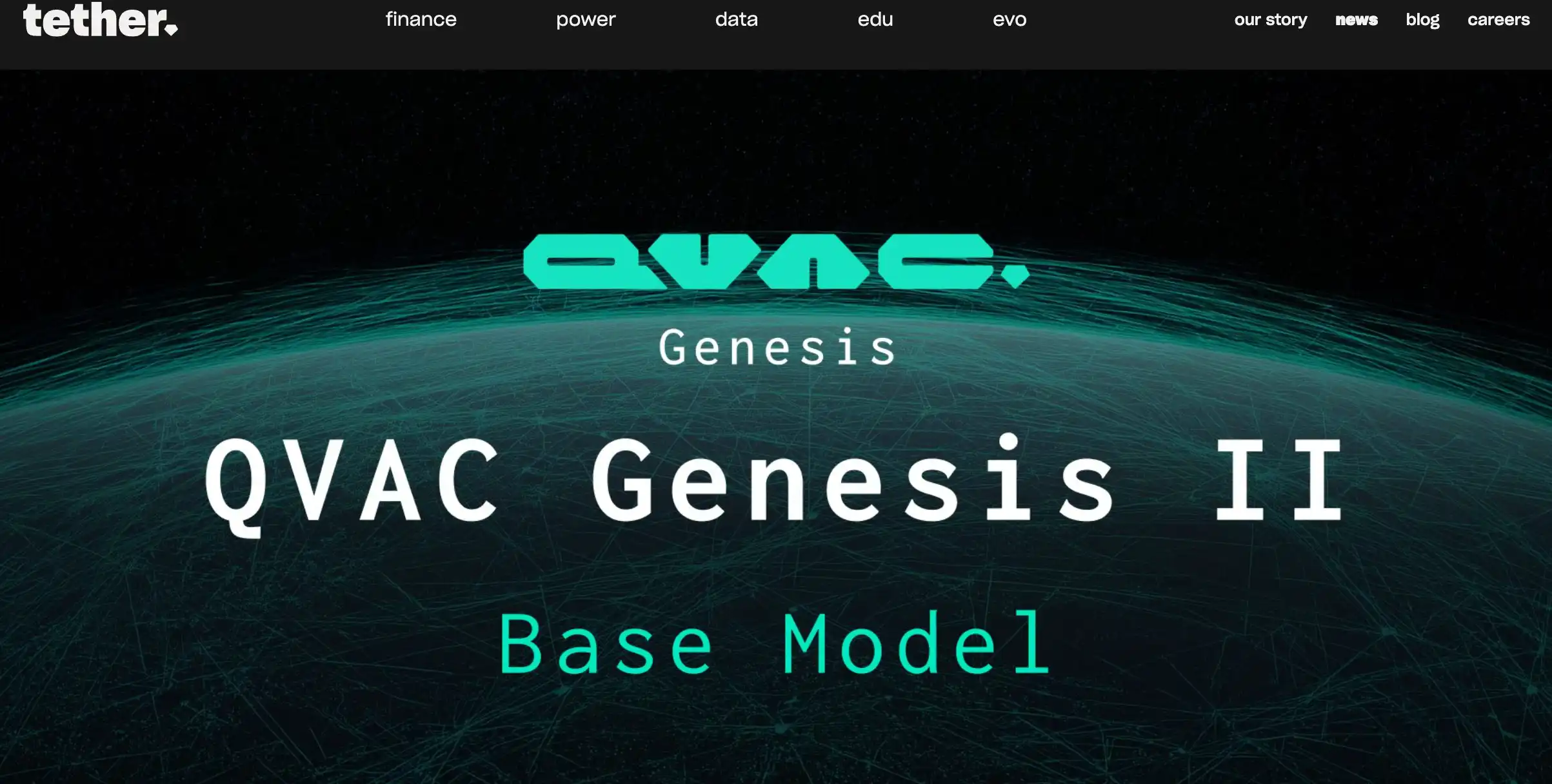
Training AI requires feeding data. Last week, Tether released a dataset called QVAC Genesis, covering 19 subjects including mathematics, physics, chemistry, and computer science. They claim it to be the world's largest open-source AI training data.
Note that the training data from OpenAI and Anthropic is not public, but Tether released theirs directly for free for anyone to use.
Now onto the more futuristic part.
In April 2024, Tether spent $200 million to acquire a company called Blackrock Neurotech. Despite the name similarities, it has no relation to BlackRock the asset manager.
This company works on brain-computer interfaces. They implant chips into people's brains, allowing paralyzed individuals to type with their mind, control wheelchairs, or operate robotic arms. It sounds like science fiction, but they started back in 2008, eight years before Musk's Neuralink.
How impressive is this company?
A total of 35 people globally have brain-computer interface chips, with 31 of them using Blackrock's technology. In 2016, a fully paralyzed patient controlled a robotic arm with their device and fist-bumped Obama. The chip in their sensory cortex allowed them to "feel" the President's hand.
Last year, this brain-computer interface company enabled an ALS patient to "speak" again, with the chip in their brain translating thoughts into speech at a rate of 62 words per minute.
Tether spent $200 million to become a major shareholder in this company.
Altogether, Tether has invested close to $1 billion in AI-related fields. It is said that they are also in talks to acquire a German robotics company for $1.2 billion. If successful, their total investment will approach $2 billion.
What does this mean?
Anthropic raised $35 billion in funding throughout 2024. The investment by Tether, from one company, is close to half of what a top-tier AI company raises.
OpenAI spent $6.7 billion on R&D in the first half of 2025. With the profits, Tether, with spare change, could play the role of a big daddy in the AI realm.
Why would a stablecoin issuer venture into AI?
We see two possibilities.
The first is anxiety. The Fed is cutting rates, bond yields are falling. Earning $7 billion in interest while lying down in 2024, things might not be as good from 2025 onwards. The money printer also needs a new narrative.
The second is ambition. The whole world is talking about AI—investors, the media, politicians. If you say you're a stablecoin company, no one pays much attention. But if you say you're working on AI, brain-machine interfaces, humanoid robots, then you are:
A technology leader.
But what's most amusing is this.
Tether is venturing into AI, chanting slogans like "decentralization," "on-device computation," and "returning intelligence to individuals."
But Tether, itself, is the most centralized company in the crypto world.
He decides when to issue coins, he decides the reserve amount. In its ten years of existence, it has never been audited. Only he knows where users' money is.
Now, this company wants to teach the world what "decentralized AI" means.
It's really quite like a casino owner offering classes on quitting gambling.
But it's not impossible.
After all, OpenAI is still losing money, projected to stop burning cash in 2029. Anthropic is in a similar situation, projected to break even in 2028. Sam Altman is fundraising everywhere, Dario Amodei is fundraising everywhere. These two companies together have lost $10 billion and are still storytelling to investors.
Tether doesn't need to do that. The money is already in his pocket.
What's the biggest challenge facing the entire AI industry? The business model.
How do you make money? Don't know. When will you make money? Don't know. Can you make money? Don't know.
Tether doesn't have this worry. His business model is simply:
Not doing AI.
The money earned from stablecoins is used to invest in AI. Making the right investment is foresight, making the wrong one is a tuition fee. In any case, it doesn't affect the core business.
Those doing AI are losing money, those not doing AI are making money. Those doing AI are fundraising, those not doing AI are investing.
The best AI business model in 2026 may be not doing AI at all.
Get your money printer right first.
You may also like

Russia’s Largest Bitcoin Miner BitRiver Faces Bankruptcy Crisis – What Went Wrong?
Key Takeaways BitRiver, the largest Bitcoin mining operator in Russia, faces a bankruptcy crisis due to unresolved debts…

Polymarket Predicts Over 70% Chance Bitcoin Will Drop Below $65K
Key Takeaways Polymarket bettors forecast a 71% chance for Bitcoin to fall below $65,000 by 2026. Strong bearish…

BitMine Reports 4.285M ETH Holdings, Expands Staked Position With Massive Reward Outlook
Key Takeaways BitMine Immersion Technologies holds 4,285,125 ETH, which is approximately 3.55% of Ethereum’s total supply. The company…

US Liquidity Crisis Sparked $250B Crash, Not a ‘Broken’ Crypto Market: Analyst
Key Takeaways: A massive $250 billion crash shook the cryptocurrency markets, attributed largely to liquidity issues in the…

Vitalik Advocates for Anonymous Voting in Ethereum’s Governance — A Solution to Attacks?
Key Takeaways Vitalik Buterin proposes a two-layer governance framework utilizing anonymous voting to address collusion and capture attacks,…

South Korea Utilizes AI to Pursue Unfair Crypto Trading: Offenders Face Severe Penalties
Key Takeaways South Korea is intensifying its use of AI to crack down on unfair cryptocurrency trading practices.…

Average Bitcoin ETF Investor Turns Underwater After Major Outflows
Key Takeaways: U.S. spot Bitcoin ETFs hold approximately $113 billion in assets, equivalent to around 1.28 million BTC.…

Japan’s Biggest Wealth Manager Adjusts Crypto Strategy After Q3 Setbacks
Key Takeaways Nomura Holdings, Japan’s leading wealth management firm, scales back its crypto involvement following significant third-quarter losses.…
CFTC Regulatory Shift Could Unlock New Opportunities for Coinbase Prediction Markets
Key Takeaways: The U.S. Commodity Futures Trading Commission (CFTC) is focusing on clearer regulations for crypto-linked prediction markets,…
Hong Kong Set to Approve First Stablecoin Licenses in March — Who’s In?
Key Takeaways Hong Kong’s financial regulator, the Hong Kong Monetary Authority (HKMA), is on the verge of approving…

BitRiver Founder and CEO Igor Runets Detained Over Tax Evasion Charges
Key Takeaways: Russian authorities have detained Igor Runets, CEO of BitRiver, on allegations of tax evasion. Runets is…

Crypto Investment Products Struggle with $1.7B Outflows Amid Market Turmoil
Key Takeaways: The recent $1.7 billion outflow in the crypto investment sector represents a second consecutive week of…

Why Is Crypto Down Today? – February 2, 2026
Key Takeaways: The crypto market has seen a downturn today, with a significant decrease of 2.9% in the…

Nevada Court Temporarily Bars Polymarket From Offering Contracts in the State
Key Takeaways A Nevada state court has temporarily restrained Polymarket from offering event contracts in the state, citing…

Bitcoin Falls Below $80K As Warsh Named Fed Chair, Triggers $2.5B Liquidation
Key Takeaways Bitcoin’s price tumbled below the crucial $80,000 mark following the announcement of Kevin Warsh as the…

Strategy’s Bitcoin Holdings Face $900M in Losses as BTC Slips Below $76K
Key Takeaways Strategy Inc., led by Michael Saylor, faces over $900 million in unrealized losses as Bitcoin price…
Trump-Linked Crypto Company Secures $500M UAE Investment, Sparking Conflict Concerns
Key Takeaways A Trump-affiliated crypto company, World Liberty Financial, has garnered $500 million from UAE investors, igniting conflict…

Billionaire Michael Saylor’s Strategy Buys $75M of More Bitcoin – Bullish Signal?
Key Takeaways Michael Saylor’s firm, Strategy, has significantly increased its Bitcoin holdings by acquiring an additional 855 BTC…
Russia’s Largest Bitcoin Miner BitRiver Faces Bankruptcy Crisis – What Went Wrong?
Key Takeaways BitRiver, the largest Bitcoin mining operator in Russia, faces a bankruptcy crisis due to unresolved debts…
Polymarket Predicts Over 70% Chance Bitcoin Will Drop Below $65K
Key Takeaways Polymarket bettors forecast a 71% chance for Bitcoin to fall below $65,000 by 2026. Strong bearish…
BitMine Reports 4.285M ETH Holdings, Expands Staked Position With Massive Reward Outlook
Key Takeaways BitMine Immersion Technologies holds 4,285,125 ETH, which is approximately 3.55% of Ethereum’s total supply. The company…
US Liquidity Crisis Sparked $250B Crash, Not a ‘Broken’ Crypto Market: Analyst
Key Takeaways: A massive $250 billion crash shook the cryptocurrency markets, attributed largely to liquidity issues in the…
Vitalik Advocates for Anonymous Voting in Ethereum’s Governance — A Solution to Attacks?
Key Takeaways Vitalik Buterin proposes a two-layer governance framework utilizing anonymous voting to address collusion and capture attacks,…
South Korea Utilizes AI to Pursue Unfair Crypto Trading: Offenders Face Severe Penalties
Key Takeaways South Korea is intensifying its use of AI to crack down on unfair cryptocurrency trading practices.…


 App
App